

In December 2026, there will be many changes to how digital marketing agencies operate due to the increased use of AI tools. Years ago, creating content took multiple hours and a lot of manpower for agencies to accomplish. Now, using a good combination of AI writing, SEO, design, automation and analytics will allow for faster delivery of projects. In addition, agencies are able to create more precise and smarter workflows that allow for faster, better results for their clients. AI has changed every aspect of the marketing process from generating first drafts of a piece of content right up to generating visibility through search and taking away the time-consuming tasks of creating reports. Using these new AI tools will allow agencies to be able to:
- Move much quicker
- Be more consistent
- There is more focus on strategy and creativity than in previous modes of operation.
Consequently, the purpose of this article is to discuss the most useful AIs for Digital Marketing Agencies in 2026, how they fit into your daily workflow as an agency and some considerations to keep in mind when deciding which AIs will best serve your agency and its clients.
AI Tools for Digital Marketing Agencies 2026
As AI tools become increasingly integral to the functioning of digital marketing agencies. With AI supporting agency teams in being able to work quickly, reduce their reliance on manual processes, and produce better-quality outputs, agencies are faced with managing ever-increasing volumes of content, and campaigns, and client expectations due to continued competition in the market and without continually increasing headcount. AI becomes a vital tool by being able to provide quicker research for agency teams (Faster Ways to Develop Content Use Artificial Intelligence - Jeffrey Justice, January 17, 2022). AI also allows teams to be able to provide new creative ideas, as well as optimizations and automating tedious tasks that usually would take a considerable amount of time. This will give agency teams more time to work on strategic objectives, creative execution, and performance enhancement. Therefore, agencies efficiently deliver their products while maintaining quality and consistency across channels and provide consistently high-quality and consistent output across channels using the principles of technology (technological advances over time).
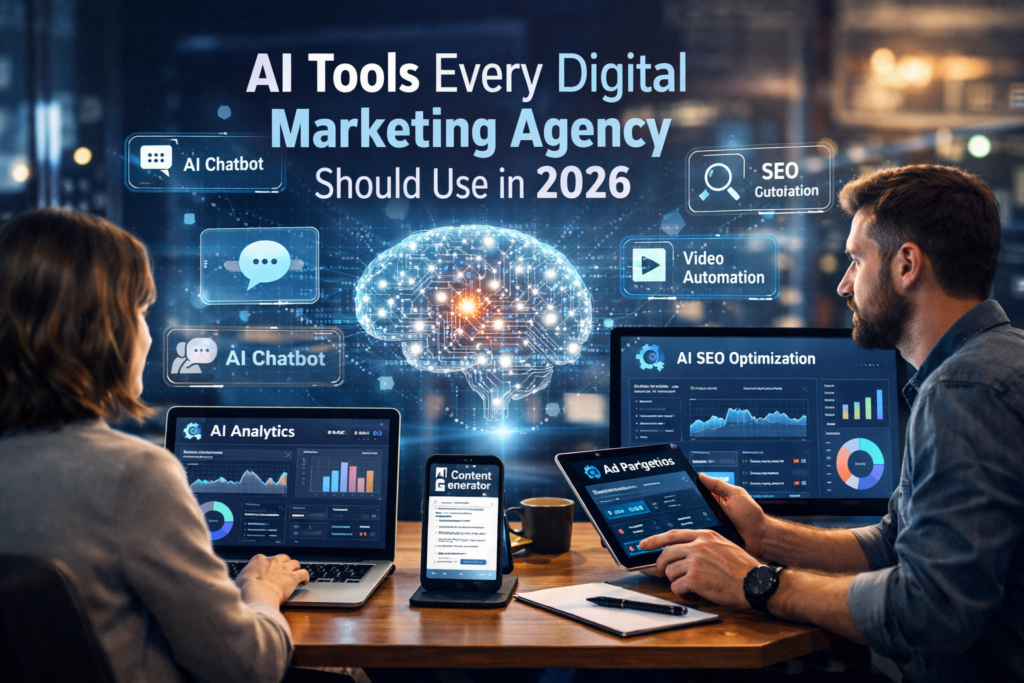
AI tools play a pivotal role in the entire marketing cycle (research, content writing, SEO optimization, design, publishing, reporting, etc.) throughout 2026, enabling organizations to enhance their performance and capabilities resulting in improved efficiencies and effectiveness by maintaining organizational and responsive behaviour while adapting quickly to changes in a fast paced digital (i.e. online) environment.
Key elements to consider:
• Agencies are able to leverage AI tools such as ChatGPT, Jasper, and Copy.ai to scale their operations without requiring additional human resources (i.e. adding headcount).
• Research, content writing, SEO writing, design, automation and reporting are augmented via AI tools such as Surfer SEO, Ahrefs, and SEMrush.
• AI tools augment strategy as opposed to replacing human judgement.
• AI platforms such as Notion AI and Zapier facilitate the creation of integrated workflows as opposed to isolated trials or projects.
AI Tools for Content Creation
For digital marketing agencies, the use of artificial intelligence (AI) to create content has become one of their top assets. AI content tools enable teams to produce blog posts, advertisement copy, social media captions, email sequences, landing page copy, and even outlines for content much quicker than would otherwise be possible. This greatly enhances agency productivity when there are multiple people working on several clients at the same time as it takes away the daunting task of having to generate content from scratch. Rather than having to invent new ideas, content creation teams can rely on the use of AI content creation tools to assist with idea generation, message structuring, and developing initial drafts that will be polished by human writers. The overall content generation cycle will be shortened and will provide each individual agency an opportunity to continue to publish regularly scheduled contents.
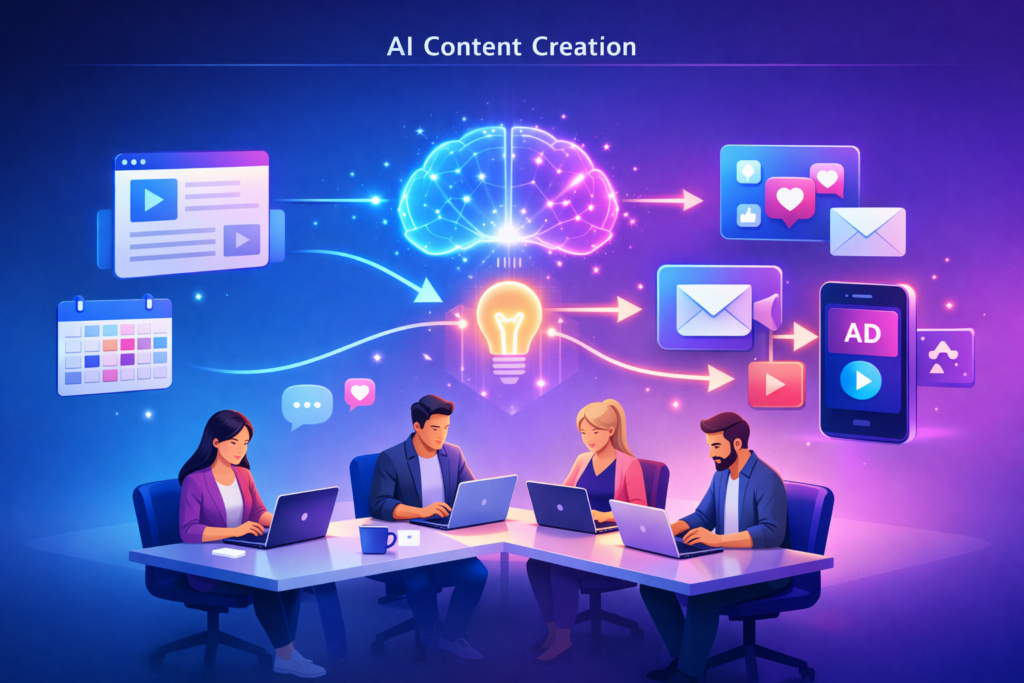
Agencies find these tools most beneficial when producing large amounts of content quickly without sacrificing quality. An AI writing assistant is able to generate multiple tones, perspectives, and versions of the same campaign, thus helping teams develop content for different types of media and audiences. For instance, one idea can be developed into a blog post, a LinkedIn post, a newsletter, and a short advertisement. The best part about using AI writing assistants is they enable agencies to use speed and flexibility to scale their production while ensuring the final product aligns with the client’s brand and business objectives.
Bullet point takeaways for content creation:
• Use AI writing tools like ChatGPT, Jasper, Writesonic to generate first drafts.
• Use AI technologies like Copy.ai and Rytr to create ideas and outlines more quickly.
• Use AI tools like Anyword to repurpose content across channels.
• Always use human editors to check for brand voice/tone/accuracy.
AI Tools for SEO and Search Visibility
SEO agencies rely heavily on AI tools due to the increased complexity of search engine optimization (SEO). In addition to simply optimizing pages by adding keywords, agencies are expected to produce content that meets the user's intentions, is in-depth enough regarding the subject matter, and performs consistently well within all forms of search: traditional search engines, and AI-assisted answer surfaces. The application of AI tools can improve keyword research, help create a topic outline, provide briefs for creating high-quality content, and assist agencies with on-page optimization activities (for example, provide recommendations for improved structure, suggest synonyms, and highlight content gaps). By using these tools, agencies can reduce the amount of time they spend on planning and increase the likelihood of achieving strong SEO results.
Agencies that partner with local businesses often utilize Artificial Intelligence (AI) tools to improve their local search engine optimization (SEO) efforts. These tools can be useful for producing location-specific content, providing assistance in the optimization of Google Business Profile, and creating pages for specific service types by region or neighborhood. This can be a tremendous benefit to agencies that support businesses which rely heavily on generating leads within their local community. In addition, rather than creating all of the website pages by hand from the ground-up, teams are able to take advantage of AI tools to efficiently create scalable amounts of localized content that remain relevant to each market.
SEO-focused pointers:
• Utilize tools like Surfer SEO, Clearscope and Frase to determine search intent through AI
• Utilize tools like Ahrefs, SEMrush, and Ubersuggest for effective keyword research via AI
• Utilize BrightLocal and Local Falcon to scale (using AI) local search engine optimization (SEO) efforts
• Always verify the accuracy of any AI-produced content intended for use as search engine optimization (SEO) material.
To Conclude
Digital marketers are witnessing a transformation in the way they work with the introduction of AI technology into their marketplace, which will greatly impact how agencies operate moving forward. The most profitable agencies will not be defined by the number of AI tools they use, rather by how effectively and efficiently they are using tools relevant to their business workflows. These AI tools can assist agencies in the areas of content creation, search engine optimization, process automation and client reporting to ensure efficiency in their agency operations, but the real advantage will be from how many agencies implement their business strategies using both the efficiency of AI and the creativity, judgement, and strategic thinking skills of agency professionals.
For agencies to remain competitive in the marketplace, they must also strategically implement an AI tool stack focused on workflow process efficiency, content quality and measurable results. Agencies can improve their overall business processes through continuous optimization of their processes by utilizing both AI tools and their own business acumen to help scale their agency and provide the best possible results for their clients.
